Bushfire Attack Level (BAL) Ratings Explained: How Buyers Agents Assess Bushfire Risk and Insurance Implications
Complete guide to BAL ratings for buyers agents: construction requirements, insurance implications, property values, and bushfire risk assessment in Australian property markets.
Bushfire Attack Level (BAL) Ratings Explained: How Buyers Agents Assess Bushfire Risk and Insurance Implications
Australia's bushfire risk is a defining characteristic of the property landscape, particularly in regional areas, semi-rural suburbs, and properties near bushland. For buyers agents, understanding Bushfire Attack Level (BAL) ratings is essential when evaluating properties, advising clients on risk, and ensuring they understand construction requirements and insurance implications.
This comprehensive guide explains BAL ratings, how they're determined, their impact on property value and insurance, and what buyers agents need to know when purchasing properties in bushfire-prone areas.
What Is a Bushfire Attack Level (BAL) Rating?
A Bushfire Attack Level (BAL) rating is a measure of a building's potential exposure to ember attack, radiant heat, and direct flame contact in the event of a bushfire. The rating system was introduced as part of Australian Standard AS 3959:2018 'Construction of buildings in bushfire-prone areas' and is now mandatory for new construction in designated bushfire-prone areas across Australia.
The BAL system classifies properties into six categories, ranging from BAL-LOW (minimal bushfire risk) to BAL-FZ (Flame Zone, the highest risk category). Each category triggers specific construction requirements designed to improve a building's resistance to bushfire attack.
For buyers agents, BAL ratings affect:
- Construction costs for new builds or substantial renovations
- Insurance premiums and availability
- Property values and marketability
- Ongoing maintenance requirements
- Client safety and peace of mind
The Six BAL Categories Explained
Understanding each BAL category helps buyers agents assess risk and explain implications to clients:
BAL-LOW
The lowest risk category. Properties in this category have insufficient risk to warrant specific construction requirements.
- Risk level: Very low ember attack risk
- Construction requirements: Standard Building Code of Australia (BCA) requirements only
- Insurance impact: Minimal - standard premiums apply
- Typical locations: Established suburbs well clear of bushland
BAL-12.5
Low level of bushfire attack from burning embers and low levels of radiant heat.
- Risk level: Low ember attack, radiant heat up to 12.5 kW/m2
- Construction requirements: Basic ember protection, screened vents, sealed gaps
- Insurance impact: Slightly elevated premiums, generally insurable
- Typical locations: Properties 100-200m from bushland with managed vegetation
BAL-19
Increased level of bushfire attack from embers, burning debris, and radiant heat.
- Risk level: Moderate ember attack, radiant heat up to 19 kW/m2
- Construction requirements: Ember-resistant construction, protected windows, specific roofing materials
- Insurance impact: Moderately higher premiums, most insurers will cover
- Typical locations: Properties within 100m of bushland or moderate vegetation
BAL-29
High level of bushfire attack from embers, burning debris, and significant radiant heat.
- Risk level: High ember attack, radiant heat up to 29 kW/m2
- Construction requirements: Substantial ember and radiant heat protection, limited timber use externally
- Insurance impact: Significantly higher premiums, some insurers may decline
- Typical locations: Properties within 50m of significant bushland
BAL-40
Very high level of bushfire attack from embers, burning debris, radiant heat, and some flame contact.
- Risk level: Extreme ember attack, radiant heat up to 40 kW/m2, potential flame contact
- Construction requirements: Extensive bushfire protection, non-combustible materials for most elements
- Insurance impact: Very high premiums, many insurers will not provide cover
- Typical locations: Properties immediately adjacent to dense bushland
BAL-FZ (Flame Zone)
The highest risk category, where direct flame contact is likely.
- Risk level: Direct flame contact expected, extreme radiant heat
- Construction requirements: Stringent non-combustible construction, extreme ember protection
- Insurance impact: Often uninsurable through standard policies
- Typical locations: Properties within dense forest or immediately adjacent to unmanaged bushland
Buyers agents should be aware that properties rated BAL-40 or BAL-FZ face significant challenges with insurance, resale, and safety. These properties require careful client counselling and may not be suitable for risk-averse buyers.
How BAL Ratings Are Determined
BAL ratings are assessed using the methodology outlined in AS 3959:2018. The assessment considers:
1. Fire Danger Index (FDI)
The FDI measures the potential for bushfire on a given day based on temperature, humidity, wind speed, and fuel availability. Australia uses regional FDI values - for example, Victoria and South Australia typically use FDI 80, while NSW may use FDI 100 for more extreme conditions.
2. Vegetation Classification
The type and density of vegetation surrounding the property significantly impacts BAL rating:
- Forest: Dense tree coverage with continuous canopy
- Woodland: Trees with open canopy, grass understory
- Shrubland: Dense shrubs and low vegetation
- Grassland: Predominantly grass with minimal trees
- Mallee/heath: Low multi-stemmed eucalypts and heath vegetation
Each vegetation type has different fire behaviour characteristics that affect BAL assessment.
3. Distance to Vegetation (Effective Slope)
The distance from the building to classified vegetation is critical. Generally, greater distance reduces BAL rating. However, this distance must be measured considering slope:
- Upslope: Fire travels faster uphill, increasing risk even at greater distances
- Flat land: Standard distance measurements apply
- Downslope: Fire travels slower downhill, reducing effective risk
A property 100m from bushland on flat ground might be BAL-12.5, while the same distance upslope could be BAL-29 or higher.
4. Exclusions and Modifications
Certain features can modify BAL assessments:
- Water bodies: Large lakes, rivers, or reservoirs act as fire breaks
- Roads and cleared areas: Wide roads or cleared land reduce effective vegetation proximity
- Managed vegetation: Well-maintained, low-fuel vegetation may be assessed differently than dense bushland
BAL Assessments: When Are They Required?
BAL assessments are typically required in the following situations:
New Residential Construction
Any new dwelling in a designated bushfire-prone area must have a BAL assessment completed before construction approval. This assessment is submitted with development applications.
Substantial Renovations
Major renovations or extensions may trigger BAL requirements if the work exceeds certain thresholds. Requirements vary by state and local council.
Subdivisions
New subdivisions in bushfire-prone areas require BAL assessments at the planning stage to inform lot layouts and asset protection zones.
Building Insurance
While not always legally required, insurers increasingly request BAL assessments for properties in bushfire-prone areas to accurately price risk.
Buyers agents should note that existing dwellings built before BAL requirements were introduced typically do not have BAL ratings unless they've been assessed for insurance purposes. This doesn't mean the property is safe - it simply predates the regulatory framework.
Construction Requirements by BAL Rating
Each BAL category triggers specific construction requirements under AS 3959. Buyers agents should understand these requirements when advising clients on new builds or renovations:
BAL-12.5 Requirements
- Ember-guard mesh screens on vents and openings (2mm maximum aperture)
- Sealed gaps around windows and doors
- Class 1 or 2 roof covering (non-combustible or low fire risk)
- Basic protection for external timber elements
Cost impact: Approximately 1-2% additional construction cost.
BAL-19 Requirements
- All BAL-12.5 requirements plus:
- Bushfire shutters or ember-resistant windows
- Protected eaves and fascias
- Limited use of combustible materials on external walls
- Specific requirements for decks and verandahs
Cost impact: Approximately 2-4% additional construction cost.
BAL-29 Requirements
- All BAL-19 requirements plus:
- Non-combustible external walls or ember-resistant cladding
- Protected window assemblies
- Enclosed subfloor spaces or non-combustible materials
- Restricted timber use for external elements
Cost impact: Approximately 4-7% additional construction cost.
BAL-40 Requirements
- All BAL-29 requirements plus:
- Non-combustible external walls
- Metal-framed bushfire-rated windows
- Minimal external timber use
- Fully enclosed, protected subfloor spaces
Cost impact: Approximately 7-12% additional construction cost.
BAL-FZ (Flame Zone) Requirements
- All BAL-40 requirements plus:
- Stringent non-combustible construction throughout
- Extreme ember and flame contact protection
- Specialist bushfire engineering may be required
Cost impact: Approximately 12-20% additional construction cost, potentially higher.
These cost increases can be substantial on larger homes. A $500,000 new build at BAL-29 could cost an additional $20,000-$35,000 compared to BAL-LOW construction.
Insurance Implications of BAL Ratings
BAL ratings have become a key factor in property insurance underwriting and pricing:
Premium Increases
Higher BAL ratings typically result in significantly higher insurance premiums:
- BAL-LOW: Standard premiums
- BAL-12.5: 10-20% premium increase
- BAL-19: 20-40% premium increase
- BAL-29: 40-100% premium increase
- BAL-40: 100-200% premium increase (if coverage available)
- BAL-FZ: Often uninsurable or requires specialist underwriting
A property with standard annual insurance of $2,000 at BAL-LOW could cost $4,000-$6,000 annually at BAL-40 - an additional $2,000-$4,000 per year in holding costs.
Policy Exclusions and Conditions
Properties with higher BAL ratings may face:
- Higher excess amounts for bushfire claims
- Requirements to maintain asset protection zones
- Mandatory bushfire safety measures (e.g., ember guards, shutters)
- Exclusion of certain outbuildings or structures
- Seasonal coverage restrictions during fire danger periods
Insurability Challenges
Properties rated BAL-40 or BAL-FZ often face significant challenges securing insurance:
- Many major insurers decline to provide cover
- Specialist insurers may offer coverage at very high premiums
- Coverage may be conditional on extensive bushfire preparation
- Lenders may refuse mortgages on uninsurable properties
Buyers agents must ensure clients understand that a BAL-40 or BAL-FZ property may be effectively unmortgageable if insurance cannot be obtained.
Impact on Property Value and Marketability
BAL ratings affect property values in several ways:
Direct Cost Impacts
- Higher construction costs reduce equity on new builds
- Ongoing insurance costs reduce cash flow for investors
- Maintenance costs for bushfire protection measures
Market Perception
- Higher BAL ratings may deter some buyers
- Properties with known bushfire risk often sell at a discount
- Market demand declines significantly for BAL-40 and BAL-FZ properties
Buyer Pool Reduction
- Properties requiring specialist insurance have fewer potential buyers
- Uninsurable properties can only sell to cash buyers
- First home buyers often avoid higher BAL areas due to insurance and safety concerns
Buyers agents should advise clients that while properties in bushfire-prone areas may offer attractive amenity and lifestyle, the long-term financial impact of high BAL ratings can be substantial.
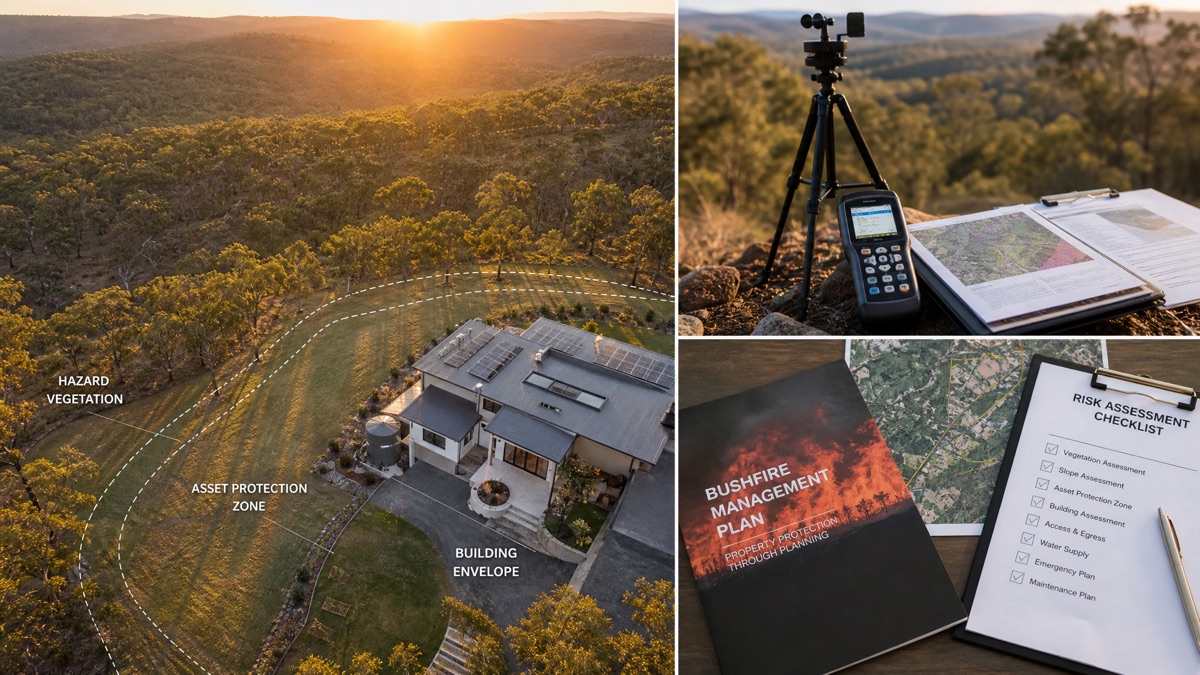
Asset Protection Zones (APZ)
Asset Protection Zones are managed areas of land around buildings designed to reduce bushfire risk. APZs are often required as part of development approvals in bushfire-prone areas.
Inner Protection Area (IPA)
The area immediately surrounding the building (typically 10-20m):
- All vegetation within 2m of the building must be removed or managed
- Tree canopies must be separated
- Grass must be kept mown and green
- No bark, mulch, or combustible materials near the building
- Gutters and roof spaces must be kept clear of leaves and debris
Outer Protection Area (OPA)
The area beyond the IPA (up to 100m from the building):
- Vegetation management to reduce fuel loads
- Tree canopy separation requirements
- Removal of dense understorey vegetation
- Grass management and fire break maintenance
Buyers agents should inform clients that APZ maintenance is often a condition of planning approval and insurance coverage. Failure to maintain the APZ can void insurance policies and trigger council compliance action.
Due Diligence for Buyers Agents
When assessing properties in bushfire-prone areas, buyers agents should:
Check Bushfire Overlay Maps
Each state maintains bushfire overlay maps identifying bushfire-prone areas. These are typically available through state planning portals or local council websites.
Obtain BAL Assessments
For new builds or recent constructions, request the BAL assessment report. For existing properties without assessments, consider recommending clients obtain one for insurance and safety planning purposes.
Review Planning Conditions
Check development approvals for APZ requirements, ongoing maintenance obligations, and any bushfire-specific planning conditions.
Assess Insurance Availability
Before proceeding with a purchase, confirm that building insurance is available and obtain indicative premium quotes. Properties rated BAL-40 or higher should have insurance confirmed before exchange.
Evaluate Vegetation Management Requirements
Assess the practical ability to maintain required APZs. Large properties with extensive bushland may require significant ongoing management effort and cost.
Consider Access and Evacuation
Properties in high bushfire risk areas should have clear evacuation routes and multiple access points where possible. Dead-end roads or single-access properties increase risk.
Client Communication and Risk Disclosure
Buyers agents have a professional obligation to ensure clients understand bushfire risks:
Transparent Risk Discussion
Clearly explain the BAL rating, what it means, and the practical implications for construction, insurance, and safety.
Financial Impact Modelling
Quantify the financial impact of higher insurance premiums, construction costs, and ongoing maintenance requirements.
Insurance Confirmation
Never assume insurance will be available. Confirm coverage and premium costs before proceeding.
Bushfire Preparedness Plans
Recommend clients develop bushfire preparedness plans, including evacuation procedures and property defence strategies.
Historical Fire Data
Research historical bushfire incidents in the area and provide context on fire frequency and severity.
Regional Variations and Specific Considerations
Bushfire risk varies significantly across Australian regions:
Victoria
Victoria has some of the strictest bushfire planning requirements following the 2009 Black Saturday fires. BAL assessments are mandatory in designated bushfire areas, and many councils impose additional requirements beyond AS 3959.
New South Wales
NSW uses Planning for Bush Fire Protection guidelines in addition to AS 3959. Properties in bushfire-prone areas require Section 10.7 certificates disclosing the bushfire risk.
Queensland
Queensland's bushfire planning framework includes State Planning Policy provisions. BAL assessments are required in medium and high bushfire hazard areas.
South Australia
SA has specific bushfire management area overlays, particularly in the Adelaide Hills and regional areas. BAL assessments are mandatory for new builds in these zones.
Western Australia
WA applies bushfire protection requirements through the Bushfire Protection Planning Policy. BAL assessments are required in designated bushfire-prone areas.
Tasmania
Tasmania uses the Tasmanian Bushfire-Prone Areas Code, which requires BAL assessments for new buildings in designated areas.
Frequently Asked Questions
Can a BAL rating change over time?
Yes. If vegetation around the property changes (e.g., bushland is cleared, or new growth increases fuel loads), the BAL rating may change. Properties should be reassessed if significant vegetation changes occur.
Do existing homes have BAL ratings?
Only if they've been formally assessed. Homes built before BAL requirements were introduced typically don't have ratings unless assessed for insurance or renovation purposes.
Can I build a standard home in a BAL-29 area?
No. You must meet the construction requirements for BAL-29, which include ember protection, specific materials, and design features. Standard construction is only permitted in BAL-LOW areas.
How much does a BAL assessment cost?
BAL assessments typically cost between $400 and $1,200 depending on property size, complexity, and location. Complex sites with multiple vegetation types or difficult terrain may cost more.
Can I reduce my BAL rating by clearing vegetation?
Potentially, yes. Increasing the distance between the building and classified vegetation, or reducing fuel loads, can lower BAL ratings. However, vegetation clearing often requires permits and must comply with environmental regulations.
Is a high BAL rating a deal-breaker?
It depends on the client's risk tolerance and financial capacity. Some buyers are comfortable with BAL-29 properties if they understand the requirements. BAL-40 and BAL-FZ properties are typically only suitable for very specific buyers.
Do I need a BAL assessment for a renovation?
It depends on the scope of work and local council requirements. Minor renovations typically don't trigger BAL requirements, but substantial alterations or extensions often do. Check with the local council and building surveyor.
Can I get a mortgage on a BAL-FZ property?
It's very difficult. Most lenders require building insurance, and BAL-FZ properties are often uninsurable through standard policies. Cash buyers or specialist lenders may be the only options.
Final Recommendations for Buyers Agents
Bushfire risk is a critical consideration in Australian property purchases. Buyers agents who understand BAL ratings and their implications provide essential guidance to clients navigating bushfire-prone areas.
Key takeaways:
- Always check bushfire overlay maps during property searches
- Obtain or commission BAL assessments for properties in bushfire-prone areas
- Confirm insurance availability and costs before proceeding with purchases
- Factor construction cost premiums into budgets for new builds
- Clearly communicate financial and safety implications to clients
- Recommend specialist advice for BAL-40 and BAL-FZ properties
- Document all bushfire risk discussions and client acknowledgments
By thoroughly understanding BAL ratings and integrating bushfire risk assessment into your service, you protect your clients from unforeseen costs and safety risks while demonstrating the depth of expertise that separates exceptional buyers agents from the rest.