The Buyers Agent's Guide to Property Portfolio Strategy: Building Multi-Property Wealth for Australian Investors
Master property portfolio strategy to help clients build multi-property wealth. Learn sequencing, diversification, serviceability management, and the three core portfolio approaches every buyers agent needs.
The Buyers Agent's Guide to Property Portfolio Strategy: Building Multi-Property Wealth for Australian Investors
For many Australian property investors, the journey doesn't end with their first purchase. The real wealth creation happens when you build a strategic property portfolio - multiple properties working together to compound growth, generate income, and create long-term financial security. As a buyers agent, understanding portfolio strategy isn't just an added skill - it's essential for helping ambitious clients scale their investments intelligently.
This comprehensive guide will walk you through everything you need to know about advising clients on multi-property portfolios, from structuring their first expansion to managing a mature portfolio of five or more properties.
Why Portfolio Strategy Matters More Than Single Property Selection
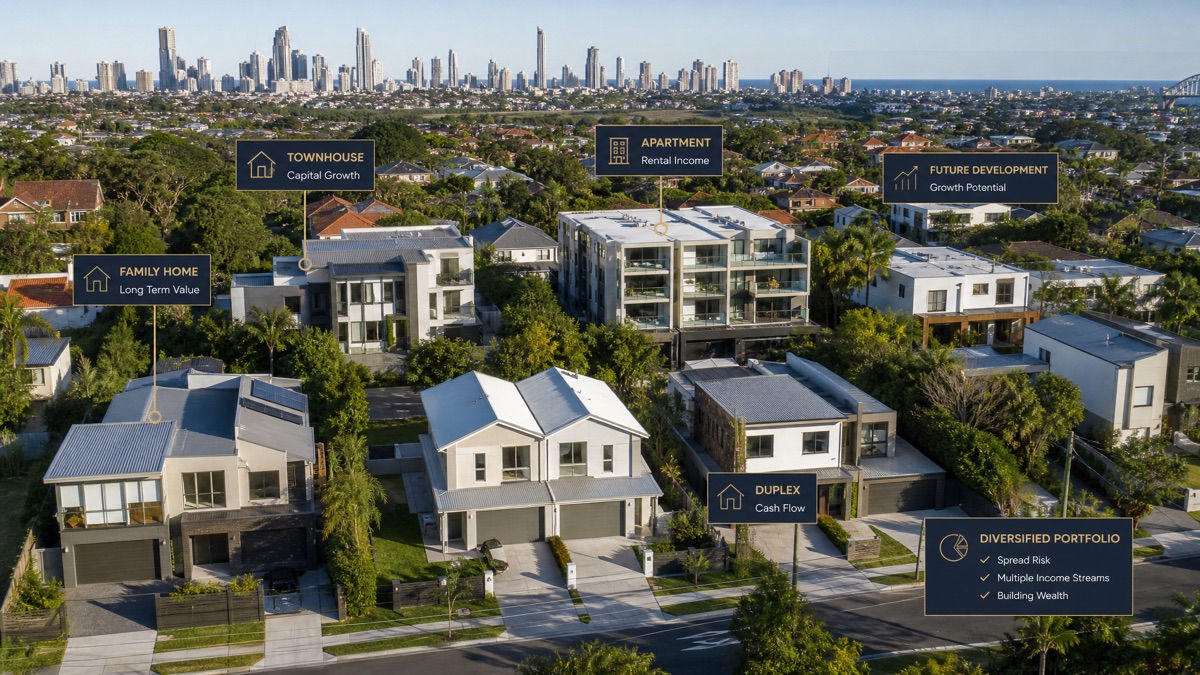
The difference between owning three properties and owning a strategic property portfolio is like the difference between having ingredients and having a recipe. Each property in a well-designed portfolio serves a specific purpose:
- Growth engines - Capital city properties in gentrifying areas that appreciate faster than the market average
- Cash flow generators - Regional or high-yield properties that cover their own costs and subsidise the portfolio
- Diversification assets - Properties in different markets, states, or property types that reduce overall risk
- Future development plays - Sites with subdivision or development potential for value-add strategies
Your role as a buyers agent shifts from "find me a good property" to "help me build a portfolio that works as a system." This requires a fundamentally different approach to property selection, timing, and client advising.
The Three Core Portfolio Strategies Every Buyers Agent Should Know
1. The Growth-Focus Portfolio (Capital Appreciation Strategy)
This strategy prioritises long-term capital growth over immediate cash flow. It's ideal for clients with strong income who can afford to subsidise properties in the short term while building equity for future wealth.
Typical structure:
- Multiple properties in capital cities or strong regional centres
- Focus on areas with infrastructure investment, population growth, and gentrification
- Willingness to accept negative gearing in exchange for capital growth
- Target properties 10-20 km from CBD in growth corridors
Client profile: High-income professionals (doctors, lawyers, senior executives) who maximise negative gearing tax benefits while building long-term wealth. They typically hold properties for 10+ years and refinance to access equity for further purchases.
Your role: Identify suburbs before the market does, understand infrastructure plans, track rezoning applications, and time purchases ahead of major announcements. You need to be across council development plans, transport infrastructure, and demographic trends.
2. The Cash Flow Portfolio (Income Strategy)
This strategy prioritises immediate rental yield and positive cash flow. Properties pay for themselves from day one, allowing clients to scale faster without relying on external income to service debt.
Typical structure:
- Regional properties, dual-occupancy setups, or boarding house conversions
- High rental yields (6-8%+) that cover all costs including maintenance reserves
- Lower capital growth expectations but faster portfolio expansion
- Often includes short-term accommodation or commercial tenancies
Client profile: Investors seeking financial independence through passive income, retirees building income streams, or clients with lower serviceability who can't afford negative gearing.
Your role: Find properties in markets with strong rental demand but lower purchase prices - think regional mining towns, university cities, or holiday destinations. You need to understand rental yield calculations, vacancy rates, and local employment drivers.
3. The Balanced Portfolio (Hybrid Strategy)
Most successful portfolios use a balanced approach - combining growth and cash flow properties to create a self-sustaining system.
Typical structure:
- 2-3 capital city growth properties for appreciation
- 2-3 regional or high-yield properties for cash flow
- Cash flow from regional properties subsidises holding costs of growth properties
- Staged purchasing over 5-10 years as equity builds
Client profile: The majority of serious investors - people who want wealth creation but need the portfolio to become self-funding over time.
Your role: Help clients sequence their purchases correctly. Typically: start with a growth property to build equity, then add cash flow properties to improve serviceability, then leverage equity for the next growth property. It's chess, not checkers.
Sequencing and Timing: The Make-or-Break Factor
The order in which clients acquire properties matters as much as the properties themselves. Poor sequencing kills portfolios before they reach critical mass.
The Classic Sequencing Mistake
Many investors buy three similar properties in the same city over three years. They hit a serviceability wall because all three properties require subsidising, and they haven't built enough equity to access for further deposits.
The Strategic Sequencing Approach
Year 1: Purchase primary growth property in capital city (e.g., Brisbane or Melbourne growth corridor). Client subsidises $8,000-12,000 per year but builds equity as market appreciates.
Year 3: Refinance to access equity growth. Purchase high-yield regional property (e.g., Toowoomba, Ballarat) that generates positive cash flow of $5,000-8,000 per year.
Year 5: Portfolio is now partially self-funding. Use combined equity from both properties plus improved serviceability to purchase second growth property.
Year 7: Add another cash flow property to further improve serviceability.
Year 10: Portfolio of 4-5 properties with balanced cash flow and substantial equity growth. Client can now choose to consolidate, refinance for renovations, or continue expanding.
As the buyers agent, you need to map this timeline with clients upfront. Show them the 10-year roadmap, not just the next purchase.
Geographic Diversification: Don't Put All Eggs in One Market
One of the biggest risks in Australian property portfolios is geographic concentration. If all your client's properties are in the same city or region, they're exposed to:
- Local economic downturns (e.g., mining bust, industry collapse)
- Regional oversupply from new developments
- Natural disasters affecting an entire area
- State-specific policy changes (e.g., land tax, stamp duty reforms)
The Smart Diversification Framework
Rule of thumb: No more than 40% of portfolio value in a single state, no more than 20% in a single suburb.
Example balanced portfolio:
- 2 properties in Victoria (1 Melbourne growth, 1 regional Ballarat)
- 2 properties in Queensland (1 Brisbane growth, 1 Sunshine Coast yield)
- 1 property in NSW (Sydney fringe or regional Newcastle)
This structure protects against state-specific downturns while maintaining manageable travel for inspections and management.
Your challenge as a buyers agent: You need market knowledge beyond your home state. Either build expertise in 2-3 key markets, partner with buyers agents in other states, or use data tools to assess markets you can't visit regularly.
Serviceability: The Portfolio Killer Nobody Talks About Enough
The number one reason property portfolios stall isn't market crashes or bad purchases - it's serviceability. Your clients run out of borrowing capacity before they run out of equity or ambition.
Understanding How Banks Assess Portfolio Serviceability
Banks don't just look at individual property loans - they assess the entire portfolio's ability to service debt. Here's what they consider:
- Rental income: Typically only 80% of actual rent is counted (to account for vacancies and costs)
- Interest rate buffer: Banks assess at 3% above actual rate (e.g., test at 9% even if you're paying 6%)
- Existing commitments: Every property loan reduces available borrowing capacity
- Living expenses: Banks use HEM (Household Expenditure Measure) which often exceeds actual spending
The brutal math: A couple earning $200,000 combined might qualify for $1.2M for their first property but only $400K for their third, even if they have $300K in equity available.
Strategies to Maximise Serviceability
1. Add high-yield properties to improve income: A regional property returning 7% yield improves serviceability far more than a 3% yield capital city property, even if the capital city property grows faster.
2. Pay down debt strategically: Some investors make extra repayments on investment loans to reduce commitments, improving serviceability for the next purchase. Just ensure the loan has redraw facility.
3. Use different lender policies: Some banks assess rental income at 90%, others at 80%. Some use actual living expenses, others use HEM. Your mortgage broker partner needs to understand which lenders help portfolio investors most.
4. Increase household income: Sometimes the best property strategy is career advancement or a partner returning to work. Brutal truth: $20K extra income often adds more borrowing capacity than $100K in equity.
5. Consider commercial property: Commercial properties often have longer leases and are assessed differently for serviceability. A commercial property with a 5-year lease might be weighted more favourably than residential.
Equity Access and Refinancing Strategy
Equity is the fuel that powers portfolio expansion. Your job is helping clients access it efficiently without over-leveraging.
When to Refinance for Equity Access
The 20% rule: Most investors refinance when property equity exceeds 20% of purchase price. Example: bought for $600K, now worth $750K = $150K equity. At 80% LVR, can access approximately $120K for next deposit while maintaining 80% LVR on the first property.
Timing considerations:
- Rising markets: Refinance annually to capture equity growth quickly
- Flat markets: Wait 2-3 years to avoid unnecessary refinancing costs
- Before major purchases: Refinance 3-6 months before intended next purchase to have pre-approval ready
The LVR Balance: Conservative vs Aggressive
Conservative approach (65-70% LVR):
- Lower risk, easier to weather market downturns
- Slower portfolio growth
- Lower borrowing costs
- More buffer for market corrections
Moderate approach (75-80% LVR):
- Standard for most investors
- Avoids LMI (Lenders Mortgage Insurance) at 80%
- Good balance of growth and safety
Aggressive approach (85-95% LVR):
- Maximum leverage for fastest growth
- Requires LMI which adds significant cost
- High risk in market downturns
- Can work for very high income earners or in strong growth markets
Your advice: Most clients should stay at 80% LVR or below. Aggressive strategies look great in rising markets but can be catastrophic when markets correct by 10-15%. The investors who survived 2008-2011 and 2017-2019 downturns were the ones with conservative LVR ratios.
Property Mix: How Many of Each Type?
Clients often ask: "What's the ideal portfolio composition?" Here's a framework based on portfolio size:
Starter Portfolio (1-2 Properties)
- Focus on growth to build equity foundation
- Don't worry too much about cash flow yet
- Pick markets with strongest long-term fundamentals
Developing Portfolio (3-5 Properties)
- Introduce cash flow properties to improve serviceability
- Aim for 60% growth focus, 40% yield focus
- Start geographic diversification across 2-3 states
Mature Portfolio (6-10 Properties)
- Portfolio should be close to self-funding from rent
- 50/50 split between growth and yield typically
- Full geographic diversification
- Consider disposing of underperformers
Large Portfolio (10+ Properties)
- Fully self-funding with surplus cash flow
- Focus shifts to consolidation and optimisation
- May sell off weaker assets to pay down debt on stronger ones
- Estate planning and structure becomes critical
The Role of Property Type Diversification
Beyond geography, consider property type mix:
- Houses: Better capital growth, land appreciation, appeal to families
- Units/Apartments: Lower entry price, easier management, better yields in some markets
- Townhouses: Middle ground - land component plus affordability
- Dual occupancy: Higher yields, appeals to multiple tenant types
- Commercial: Different cycles, longer leases, potentially better serviceability treatment
Recommended mix for resilience: 60-70% houses, 20-30% units, 10-20% alternative (townhouse, dual occupancy, commercial).
Managing Portfolio Risk and Stress Testing
Your duty as a buyers agent extends beyond finding properties - you need to help clients understand and manage portfolio risk.
The Stress Test Questions Every Client Needs to Answer
1. What if interest rates rise 2%?
Calculate additional annual holding costs. Can the client afford $30K-50K extra per year? If not, the portfolio is too leveraged.
2. What if one property sits vacant for 6 months?
Do they have cash reserves to cover this? Rule of thumb: maintain reserves equal to 6 months holding costs for the entire portfolio.
3. What if property values drop 15%?
This happened in some markets 2017-2019. Would they be over-leveraged? Would banks force them to reduce debt? At 80% LVR, a 15% drop puts them at 94% LVR - uncomfortable but manageable. At 90% LVR, they'd be at 106% LVR - underwater and potentially facing margin calls.
4. What if their income drops 30%?
Job loss, business downturn, illness - life happens. Can the portfolio survive on rental income alone for 12 months?
Walk through these scenarios with clients BEFORE they over-commit. The investors who sleep well at night are the ones who've stress-tested their portfolios.
Exit Strategy: Planning the Endgame from the Beginning
Too many investors build portfolios without considering the exit. As a buyers agent, introduce exit planning early:
Common Exit Strategies
1. Hold Forever (Income Strategy): Build a 5-10 property portfolio, pay off loans over 20-30 years, retire on rental income. Requires patient capital and strong cash flow properties.
2. Sell Down (Consolidation Strategy): Build 8-10 properties, then sell the weakest 3-5 to pay off debt on the strongest 3-5. End with a smaller, debt-free portfolio generating income.
3. Refinance and Hold (Equity Strategy): Build substantial equity across 5+ properties, refinance at retirement to access equity for living expenses while retaining ownership.
4. Sell All (Wealth Realisation Strategy): Build portfolio for 20-30 years, sell everything, downsize personal residence, invest proceeds in shares/bonds for diversified retirement income.
Different strategies require different property selection criteria. If the plan is "hold forever," you prioritise low-maintenance properties in stable rental markets. If the plan is "sell down in 20 years," you prioritise maximum capital growth even at the cost of higher holding costs.
Advanced Strategies: When Simple Portfolios Aren't Enough
The Debt Recycling Portfolio
Some sophisticated investors use debt recycling - gradually converting non-deductible home loan debt into deductible investment debt by selling investments and paying down the home loan, then reborrowing for new investments. Complex but powerful for tax efficiency.
The Development-Led Portfolio
Instead of just buying properties, some investors buy properties with development potential - subdivide, build, sell one, keep one. This accelerates portfolio growth but requires development expertise and higher risk tolerance.
The Super Fund Portfolio
High-net-worth clients might build property portfolios inside self-managed super funds (SMSF). Different rules, tax treatment, and lending restrictions but can be highly tax-effective for retirement planning.
Your role: Recognise when strategies exceed your expertise and refer clients to specialist advisers (accountants, SMSF specialists, development consultants). Knowing your limits builds trust.
Technology and Tools for Portfolio Management
Modern portfolio investors need digital tools to track performance, manage cash flow, and make data-driven decisions:
- Portfolio tracking: Equifax, PropertyValue, CoreLogic for automated valuations
- Cash flow management: PropertyMe, Xero for tracking income/expenses across multiple properties
- Tax optimisation: Rental property depreciation schedules, tax software integration
- Equity calculators: Borrowing capacity and refinancing scenario tools
Recommend these tools to clients and help them set up tracking systems from property one, not property five.
Common Portfolio Mistakes and How to Avoid Them
Mistake 1: Buying Too Fast
Acquiring 5 properties in 2 years feels like progress but often leads to serviceability problems and cash flow stress. Better to buy 5 properties over 8-10 years with proper sequencing.
Mistake 2: Buying in the Same Market
Three properties in the same suburb means three times the exposure to local risk. Geographic diversification isn't optional.
Mistake 3: Chasing Yields Without Growth
A portfolio of 5 regional properties returning 7% yield sounds great until you realise they haven't appreciated in 10 years and you have no equity to leverage.
Mistake 4: Ignoring Holding Costs
Negative gearing is fine if planned for, catastrophic if unexpected. Always calculate true holding costs including rates, insurance, maintenance, management, and potential vacancy.
Mistake 5: No Cash Reserves
One major repair or extended vacancy shouldn't threaten the entire portfolio. Maintain reserves equal to 6-12 months holding costs.
Mistake 6: Poor Documentation and Record Keeping
Come tax time or refinancing time, clients with messy records pay more in accounting fees or miss out on deductions. Set up systems from day one.
Your Portfolio Strategy Conversation Framework
When a client comes to you saying "I want to build a property portfolio," here's your structured conversation:
Discovery Questions
- What's your 10-year wealth goal? (Be specific - dollar figure, number of properties, retirement income target)
- What's your current income and how stable is it?
- What's your risk tolerance? (Scale of 1-10, stress test scenarios)
- How much can you afford to subsidise properties per year?
- Do you have existing properties? (Review current portfolio if yes)
- What's your tax situation? (Negative gearing benefit, marginal tax rate)
- What's your exit strategy? (Hold forever, sell down, refinance and hold)
Portfolio Design
Based on answers, recommend:
- Primary strategy (growth, yield, or balanced)
- Target portfolio size (number of properties in 10 years)
- Geographic diversification plan
- Property type mix
- Rough purchase timeline and sequencing
First Purchase
Explain why you're recommending Property A as purchase #1 in the context of the overall strategy. "We're starting with a Brisbane growth property because we need to build equity for future purchases. In 3 years, we'll leverage this equity to buy a cash flow property that improves your serviceability for purchase #3."
Clients who understand the strategy stick with you for the entire journey. Clients who just get sold "good properties" disappear after purchase one.
FAQ: Property Portfolio Strategy for Buyers Agents
How many properties should a typical investor aim for?
There's no magic number, but 5-7 properties is a common "sweet spot" for most investors. This provides good diversification and income potential while remaining manageable. High-income earners might target 10-15, while others might stop at 3-4. The right number depends on income, risk tolerance, and wealth goals.
Should clients wait until one property is paid off before buying another?
Generally no. Waiting 25-30 years to pay off one property before buying another means missing decades of compounding growth and equity leverage. The exception: if a client is nearing retirement and wants to reduce debt, paying off properties can make sense. For wealth building in your 30s-50s, leverage is your friend.
Is negative gearing still worth it with lower tax rates?
Negative gearing is a tax benefit, not an investment strategy. Don't buy a bad property just for tax deductions. That said, for high-income earners (marginal tax rate 37-45%), negative gearing on growth properties can be very effective. The tax benefit subsidises holding costs while you wait for capital appreciation.
How often should clients refinance their portfolio?
In rising markets, every 2-3 years to access equity growth. In flat markets, only when needed for a specific purchase or if better interest rates are available. Refinancing has costs (application fees, valuation fees, potential exit fees) so don't do it unnecessarily.
Should all properties be in the client's personal name or use trusts/companies?
This is a legal/tax question beyond most buyers agents' scope. Refer to accountants and lawyers. Generally: personal name is simplest, discretionary trusts offer flexibility for income distribution, companies have tax disadvantages for property. Most individual investors start in personal names and might restructure later if portfolios become substantial.
What's the minimum equity needed before buying the next property?
Typically need 20-25% of next purchase price as equity (to maintain 80% LVR and avoid LMI). Example: next property costs $600K, need $120K-150K equity available plus costs ($30K). Total required: $150K-180K equity accessible.
How do you handle clients who want to buy interstate properties they've never seen?
Don't recommend it unless absolutely necessary. If interstate purchases are strategic: arrange professional inspections, video walkthroughs, detailed suburb research, and ideally at least one in-person visit. Some clients trust buyers agents to inspect on their behalf - if you take this role, document everything and manage expectations carefully.
Should clients prioritise paying down investment debt or saving for the next deposit?
Depends on stage of portfolio. Early stage (1-2 properties): prioritise saving for next deposit to keep growing. Middle stage (3-5 properties): balance both - save for deposits while making extra repayments to improve serviceability. Late stage (6+ properties): paying down debt becomes more important as portfolio matures.
What's the biggest risk in property portfolios that buyers agents overlook?
Concentration risk - too many properties in the same market, same property type, or same tenant demographic. If all your client's properties are 2-bedroom units in inner Brisbane targeting young professionals, a recession that hits young professional employment hard would devastate the entire portfolio. Diversification isn't just geography - it's property types, tenant demographics, and economic drivers.
How do you advise clients when they hit their borrowing capacity ceiling?
Four options: (1) Increase income through career advancement or partner's income, (2) Pay down debt to free up serviceability, (3) Sell an underperforming property to consolidate, (4) Wait for equity growth and rental increases to improve ratios naturally. Sometimes the best property advice is to pause and strengthen your financial position before continuing.
Conclusion: From Property Finder to Wealth Architect
Understanding property portfolio strategy transforms you from a buyers agent who finds good properties into a buyers agent who builds wealth. Your clients don't just need the next property - they need the right property in the right sequence for their long-term strategy.
Master these concepts and you'll attract the serious investors who build multi-property portfolios over decades. These clients provide recurring business, referrals, and the satisfaction of genuinely transforming someone's financial future.
The difference between a $2 million property portfolio and a $5 million portfolio often isn't better properties - it's better strategy. Be the buyers agent who provides both.